
long distance trails in Europe
Cabo de Gata
Andalusia, Spain

Cabo de Gata Coastal Trail
Andalusia, Spain
51 km. 4 days

Day 1: Cabo de Gata Lighthouse – San Jose
3 ½ hours. 13.9 km. 305 m elevation
Day 2: San Jose – Isleta del Moro
3 hours. 11.2 km. 314 m elevation
Day 3: Isleta del Moro – Las Negras
4 hours. 13 km. 429 m elevation
Day 4. Las Negras – Agua Amarga
4 hours. 12.9 km. 492 elevation
This 51 km long-distance hike along the Andalusian coast, from the lighthouse at Cabo de Gata to the tiny beach resort of Agua Amarga, can handily be organised into 4 stages, each lasting no longer than 4 hours. And at the end of every stage hikers will reach a small resort village: first San Jose, then Isleta del Moro, followed by Las Negras and finally Agua Amarga. Due to the intense heat, it is rather perilous to hike the trail in the summer, but in the spring and in autumn, it is perfectly feasible to book a one night accommodation in each of those 4 places. You have to carry your whole luggage though, as I did not come across a tour operator (yet) who might transport your luggage for you.

the twin peaks of Cerro del Fraile
How to get there:
The Parque Natural del Cabo de Gata – Nijar (to give it its official and typically comprehensive Spanish title) lies just a 45 minute drive away from the regional centre of Almeria with an international airport frequented by major budget airlines including Ryanair, Easy Jet or Jet 2. Domestic flights from Madrid and Barcelona are also on offer. We travelled during the off-season, and with very few connections to Almeria decided to fly to Malaga (a three hour drive away) and to rent a car with our preferred agency Zest Car Rental. Train aficionados have to wait a little longer for the 2-hour high speed link to Madrid scheduled to be completed in 2028. At the moment, the journey from the Spanish capital is a 6-hour slog. By far the biggest settlement in the park is the charming town of San Jose. To get there by public transport, visitors have to rely on the patchy bus service offered by Autocares Bernado; a 4 Euro bargain for the one-hour journey.
San Jose
Where to stay:
We tackled the trail in late November, and during off season finding accommodation can be tricky, with practically all hotels being boarded up for the year. We reverted to our customary approach and based ourselves in San Jose as it is the only place that has a half-decent tourist infrastructure with a supermarket, but also some cafes and restaurants that stay open year-round. We chose to rent an Air BnB but also could have splashed out on the comfortable Hotel Doña Pakyta.

Playa del Penon Blanco, Isleta del Moro
How to get around:
No public transport at this time of year; no Uber offerings either, and incredibly only one taxi outfit, manned by the jolly and talkative Vincente (mobile: 608-056-255) who has been serving the area for the best part of 30 years. For stage 1, Vincente dropped us off at the lighthouse. The day after, he picked us up in Isleta del Moro and drove us back to San Jose. For stages 3 and 4 we drove with our rental car to the start of each section, with Vincente’s Mercedes van waiting for us at the end of each day’s hike. Plenty of time being spent in his taxi; plenty of opportunities to get insider information, but also plenty of monopolist cash to be paid. Vincente set us back a cool 140 Euro.
Castillo de San Ramon, Stage 2
A Place to Eat:
In the summer, all of those four settlements are heaving with cafes, restaurants, and fast food joints. During off season, we found a couple of places that were open for lunch but at night, the setting was desolate and quiet. So we found the most popular (or only?) local joint in San Jose that offered decent grub; the inauspicious looking, yet fabulous Restaurante Casa Miguel. It gradually morphed into our home away from home. On the first evening and kitted out in our hiking gear, we attracted many inquisitive looks, on the second we were served the owner’s fiery brandy, and by the third evening we were invited to sit at the bar.

Las Negras
The Trail:
Hiking along the trail is a straightforward affair. The path is (mostly) signposted with blue and white stripes painted on rocks and fence posts that are spaced at suitable intervals. On some occasions though, I was glad to have saved the trail on my Komoot profile, as we somehow must have missed the odd marking.

Agua Amarga
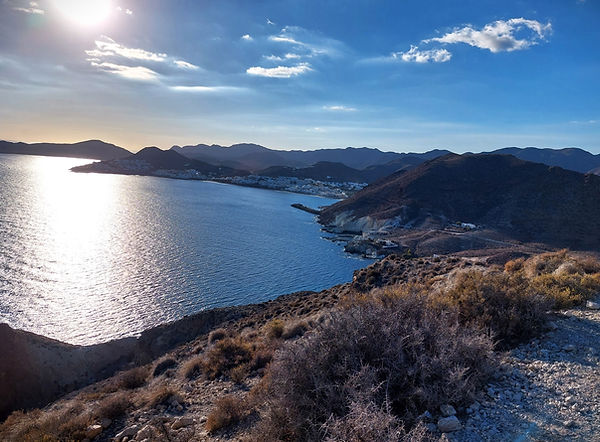
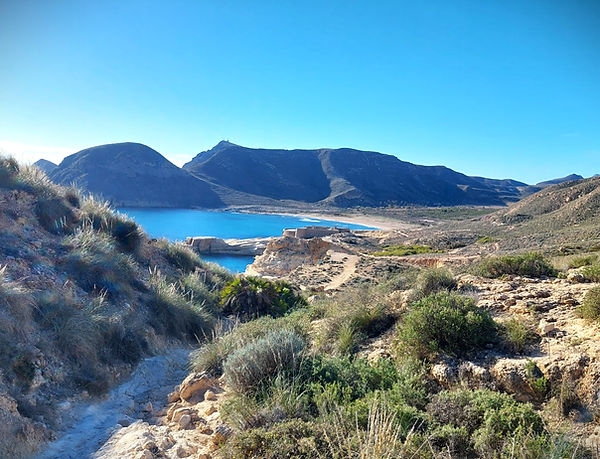
The trail winds its way up and down the coast, passing through those four villages; all rather pretty, in scenic settings and practically deserted at this time of year. Every now and then, the path turns inland and on occasion rises steeply over cliffs, yet the highest point of the entire route is at a rather modest 189 m. The first section – from the lighthouse at Cabo de Gata to San Jose - is probably the least attractive part. It follows an established gravel road used by many mountain bikers through often bleak terrain at low and hardly changing altitude. But even this section has an ace up its sleeve: the out-of-this-world landscape at the Monsul Dune, soon followed by the spectacularly long sandy stretch at Playa de los Genoveses located just before you enter San Jose. Unlike all the other sections of the trail, this area is at least partially accessible for vehicles and on a balmy weekend day, many couples and families arrived by car to enjoy this fabulous beach. But this was truly the only time when we encountered a sizeable number of people. For the remainder, we seemed to have had the trail all to ourselves.

Playa de los Genoveses
And all along the trail, at almost every turn, we encountered fabulous vistas: on one side the deep blue of the Mediterranean Sea, and on the other a harsh, barren, inhospitably looking landscape devoid of practically any vegetation. Technically speaking, the nature park is not a desert, as its annual precipitation is just above the definitional limit of 25 cm (or 10 inches). But Europe’s’ only desert - the Tabernas - is just a couple of hills away and the Cabo de Gata most certainly felt and looked like one. Bone dry, with cloudless skies, and often devoid of any sounds. I had always harboured a fascination for this kind of landscape in wintertime; the sharp light, intense shadows dancing across hillsides, the clear air and above all the sense of stillness and solitude. I can’t imagine living there, but I certainly adore visiting it. And down here, in the frying pan of Andalusia is Europe’s finest example.

a few miles inland with the village of Rodalquilar in the far distance
Winter Birds:
During the summer months, the small resorts within the park play host to mostly Spanish visitors, who are attracted to this area by the complete absence of any high-rise or large-scale developments that have pockmarked many sections of the Spanish Mediterranean coast. Thanks to the tireless efforts of local hero Doña Pakyta (she with the hotel in San Jose), this coastline has been a UNESCO protected biosphere since 1997.

Playa de las Negras
In any case, the arid landscape simply could not sustain many visitors. The water squeezed out from a small number of underground wells is already sparse. Public transport is barely worth a mention and infrastructure limited to just a few modest country roads. It seems incredible that the regional centre of Almeria, with a population of 150K is only a 45 minute drive away.

.... somewhere north of San Jose ...
Come October, and most restaurants, hotels and apartment complexes will shut down for the season. This is the time for the winter birds to arrive. Any visitor cannot fail but notice the unusually large number of RVs, trailers and camper vans, predominantly from Germany, France, and the Netherlands. Vincente told us that most campgrounds were by now full to capacity. San Jose and Isleta del Moro have banned overnight stays in most of their parking lots but walk along quiet and remote bays or stop at scenic lookout points and you will come across pension-age northern Europeans in their oversized vehicles who have forsaken their dreadful domestic winter climate for sunnier shores. No wonder. The going rate of the campgrounds seemed to be 11 Euro per night (or some 330 Euro per month) including water and electricity. Most December heating bills in any northern European city easily top that figure.

... somewhere along Stage 4 ...
Mini Hollywood:
During the Spanish Civil War, the province of Almeria sided with the Republicans, which was reason enough for Dictator Franco to neglect the area for the subsequent decades. Many emigrated to other parts of Spain, but also to work in the factories of France and Germany. The ones who stayed behind eked out a parsimonious existence until the arrival of the film industry in the 1960s gave the area an unexpected lifeline. Parts of Lawrence of Arabia were shot on Algarrobico Beach just to the north of the trail outside the town of Carboneras. Italian Director Sergio Leone used the Tabernas as the backdrop for his Spaghetti Westerns, including ‘The Good, the Bad and the Ugly’, ‘A Fistful of Dollars’, as well as ‘For a Few Dollars More’, starring Hollywood legend Clint Eastwood. Over the past 60 years more than 500 (!) movies have been shot in this cinematic landscape. Few urban dwellings, year-round sunshine, low wages, plenty of labour surplus. You don’t need to be a film producer to do the math. This article offers an interesting take on the film industry around Almeria:

film memorabilia on display at Restaurante Casa Miguel, San Jose
Europe’s Vegetable Patch:
Visitors travelling east from the relatively lush coast around Marbella and Malaga are often struck by the sudden sight of ubiquitous agricultural outfits that grow their crops under row upon row of plastic sheeting. In some places, a nondescript small town with a few houses and a small church might be completely surrounded by a sea of polytunnels; clearly one of the more bizarre sights of modern consumerism. As unsightly as it appears, this is Europe’s largest concentration of greenhouses, with the area supplying nearly half of the continent’s fruit and vegetables, in particular tomatoes, peppers, cucumbers, and melons. The transparent plastic intensifies the heat yet maintains a steady humidity so growing seasons are much longer, allowing for a doubling or even tripling (according to Vincente) of harvests. This is mind-blowing stuff.

Playazo de Rodalquilar, Stage 3
Refugees and Migrants:
But working conditions in those agricultural factories are tough, the hours long, and the pay miserable. Good luck with finding a willing workforce amongst locals or indeed from anywhere else in Europe. So, as is common practise, migrant workers often through government-regulated labour exchanges do the dirty chores. Yet the province of Almeria, with its proximity to African shorelines has for many years been a hotspot for migrant crossings. During our visit, we witnessed a battalion of Guardia Civil officers watching us closely through their binoculars from a vantage point where they had just executed a large-scale arrest of what we presumed must have been migrants who had just made the crossing. And all along the trail we spotted discarded clothes, shoes and jackets. Many migrants’ aim is to land on shore, hide out, and then to make their way into the underground and undocumented black economy. The EU’s Dublin regulation stipulates that once a migrant (illegal or otherwise) makes it to your territory, the country in question has to house, clothe, and feed them. How you then ‘deal’ with the arrivals – by for instance granting asylum or by deporting people back to the countries of origin - is down to every member state’s own rules. Of course, the frontline states of Greece, Italy and Spain have for a long time argued for an EU-wide asylum policy which naturally is being blocked by centrally located countries like Czechia, Slovakia or Hungary, who wish to take no part in a scheme that would ask for European solidarity and a sharing of costs. Down here in Almeria province, the strain on Spain’s public resources is all too apparent.

Castillo de San Pedro
Alternative Life Styles:
For the vast majority you will walk the trail in solitude. Maybe the odd runner out to get her daily endorphin kick, or a couple enjoying a leisurely stroll, but over the course of 4 days we encountered maybe half a dozen fellow hikers, though unlike us none tackled the path in its entirety. When you do bump into people, it is usually at one of the fabulous beaches that intersperse the trail, most notably at Playa de los Genoveses (stage 1), Playa del Arco (stage 2), Playazo de Rodalquilar (stage 3), as well as Cala del Plomo, Cala del Plomo and Playa Cala de Enmedio (stage 4). Even in the depth of early winter, locals went about their Sunday afternoon picknick, equipped with parasols, sun loungers and hampers, the sight of which prompting a momentary feeling of lifestyle envy.

alternative lifestyle colony at San Pedro
But the strangest encounter with fellow humans surely must have been with the residents of one of Spain’s last surviving ‘Hippie’ colony at the old military fort of San Pedro, at the halfway point between Las Negras and Agua Amarga on stage 4. The settlement is built around one of the few natural springs along this stretch of the coast and is only accessible either by boat or via a one-hour mountain track from Las Negras. The fort, although a ruin, is mightily impressive, but not so the hotchpotch collection of Decathlon tents, wooden shacks or stone shelters that surround it. But what else do you need from life but water, sunshine, home-grown vegetables and (presumably) love?

the start of the trail at Cabo de Gata
Back in the real world and hiking the final steps of the trail, I was able to reflect on the past couple of days. The trail has been nothing but a spectacular surprise. The landscape was just awesome. I adored the sense of isolation, the stillness and solitude. And of course those fabulous vistas taking in hidden coves, vast beaches, sharp cliffs and white-washed villages. No, we didn’t scale tall mountains or racked up excessive miles, but I can’t rate this trail high enough. It is one of Europe’s finest.


