
Long Distance Trails in Europe
Dry Stone Route
Mallorca, Spain

Dry Stone Route GR 221
Mallorca, Spain
9 Days
140 km
With 950,000 residents, Mallorca is by far the most populated of the Balearic Islands. Starting in the 1960s, the island was at the forefront of the development of Europe’s package tourist industry, and a total of 12 million people now visit the place each year. They are drawn to the fabulous beaches of the south coast, with resorts such as Magaluf or Playa de Palma gaining a somewhat dubious reputation for excessive partying and hedonism.

A German Outpost:
Amongst the throngs of tourists, nearly half arrive from Germany. Some enjoyed their visit so much, that they decided to relocate for good and the island is now home to 30,000 permanent German expats. Add those who own a holiday home and that figure easily doubles. Our Air BnB host falls into the permanent category. Born and raised in the Saar region on the German – French border her strong regional accent for once sounded nearly as ridiculous as mine, prompting Carlos to thank his mother for teaching him flawless high German. Our host assumed that we were here for cycling purposes, eager and ready to join the armada of Lycra enthusiasts who descend on the island to pedal up and down the hilly and curvy MA-10 which traverses Mallorca’s northern mountain range, the Serra de Tramuntana.

Valldemossa
On occasion, they might just include local resident Jan Ullrich, national icon and the only German who ever managed to win the Tour de France. That was in 1997 and achieved most likely with the aid of performance enhancing drugs. Jan though was no match for the Big Daddy of doping, the US American Lance Armstrong, who from 1999 onward won the Tour 7 times, and relegating poor Jan to second place in 2000, 2001 and 2003 (Ullrich also came second in 1998). Armstrong was declared a doping cheat in 2012, lost all his Tour titles, and was banned for life from competitive racing. The same fate also fell upon Ullrich in the same year, but unlike Lance he found himself unable to handle the public scrutiny and vitriol, with his mental health taking a turn for the worse. So much so that in 2018 he was involved in a violent confrontation with his Mallorca neighbour, the German actor Til Schweiger (one of the Inglorious Basterds in Quentin Tarantino’s movie), whose noisy party Jan had gate-crashed. He was arrested and later released with a restraining order. To his credit, Armstrong came to the rescue of his former foe, by visiting him on the island on multiple occasions to engage in some presumably EPO free cycling.

But there are also less-combustible celebrities who call Mallorca home for at least some parts of the year; most notably local hero Rafael Nadal whose tennis academy is located in Manacor in the island’s eastern flatlands. Fellow tennis legend Boris Becker also used to own a villa in Arta (just to the north of Rafael’s abode) until he was forced to sell the property in 2023 as part of his bankruptcy proceedings. Hollywood A-listers too purchased their own slice of Mallorca paradise, including Bratt Pitt (Port d’Antratx), Michael Douglas and Catherine Zeta Jones (the S’Estaca estate high up in the mountains). Singer Annie Lennox has a place near Esporles, while Claudia Schiffer still plays the occasional round of golf at Port d’Antratx, having sold her estate to a Russian oligarch for 11 million Euro some 20 years ago.

in the hills above Esporles
Which neatly brings us back to the German theme. The country’s biggest rock star, long-time north London resident Herbert Grönemeyer (and better known to international audiences as the geeky looking reporter in the anti-war film ‘Das Boot’) also has a place on the island, as does the ‘King of Mallorca’ Jürgen Drews – the title bestowed upon him by the German tabloid press – whose atrocious version of the Bellamy Brothers ‘Let your Love flow’ was probably one of the unconscious drivers in my decision to lead a life on different shores. Check out Jürgen on this YouTube clip.

When to go:
Mallorca enjoys a benign climate, which lends itself to year-round outdoor activities. Just ask all the golfers and cyclists who descend on the island even in mid-winter. A visit in July or August though, might push matters a little too far. Yes, the trail winds its way up and down a mountain range, but at a maximum height of around 1100 m, significantly cooling temperatures cannot necessarily be counted upon. During winter, the odd snow shower and icy conditions – though rare - cannot be discounted, but with a little flexibility, hiking the GR 221 during the darker months is certainly a feasible option. Most people though, including us, prefer spring or autumn. We hiked the trail on two separate visits in mid-November and in early March, and on both occasions, we enjoyed temperatures in the mid to upper teens: perfect hiking conditions.

How to do the trail:
The trail's official website suggests a total of 9 stages that take you from one mountain refuge to another. The huts though are closed from November 1 to March 31, and in any case only provide accommodation to some 30 people, but if you managed to get your bookings organised, then this could be a highly attractive option, in particular because of the low prices (around 15 EUR per night for a dorm bunkbed).
There are also several tour operators who offer pre-booked accommodation at the various trail ends, whilst also taking care of your luggage. Try for instance Mac’s Adventure. This is a highly convenient way to do the trail, yet it can also be pricy, and you can expect to pay nearly double compared with making your own arrangements. Some of the operators’ itineraries also do not feature the whole trail but merely focus on certain sections. To organise the hike independently, you need to book accommodation in the villages that function as endpoints of the individual stages. The usual suspects, including Air BnB and Booking.com have plenty of options. But you would be well advised to pack lightly as you have to haul your belongings with you.
Or you can do what we did. Stay in one place, and each day drive with a rental car to the starting point of each stage before making your way back using either public transport, taxis or Uber vehicles. For the southern section of the trail, we based ourselves in Valldemossa, a very picturesque village that nonetheless can get busy at times with day trippers. Esporles, offering an an authentic vibe of locals going about their daily business, might also be a good option. For the northern section we chose the charming regional centre of Pollença.

Valldemossa
How to get around:
As to public transport, Mallorca has an excellent bus service called Transports de les Illes Balears, or TIB (for specific timetables click here). But be careful of the differing summer and winter schedules, which change over on November 1 and April 1. In the summer, a frequent service conveniently drives along the MA-10 all the way from Port D’Antratx to Esporles and back, which is perfect for doing stages 1 to 3. However, in the winter that same bus route leaves you stranded in Estellencs (the endpoint of stage 2). There is also a blank spot between Esporles and Valldemossa (stage 4), which would necessitate taking two buses via the island’s capital La Palma. For stages 5 and 6, TIB links Valdemossa with Deia, and further on with Soller. And for stages 7 and 8, we opted for out-and-back hikes, which meant that we could simply park our car at the trail head. Stage 9 though is a headache since Pollença and Lluc can only be reached by an arduous two-hour bus journey. This is when Uber comes in handy. The service works very well on the island. We used it on several occasions.

Places to Eat.
Food aficionados might raise an unappreciative eyebrow at this idea: Instead of dining out in different restaurants, we decided to return to the same chosen eatery each evening. And since we only spent a relatively compact time in each place, the menus of our two chosen establishments offered plenty of options. The advantage of this approach is that by the second visit, staff and local patrons started to recognise us, and were much more open to chats and gossip. We found this to be a highly informative and above all entertaining way to try and connect with a place that we were not familiar with.
In Valldemossa, we ate at the unassuming Insieme; more of a local bar than a restaurant located at the entrance to the Old Town. And in Pollença we had a daily blast at 9 Sandanar. The prices are unbeatable, and so is the atmosphere.

Port D'Antratx
Towns and Villages along the Way
Estellencs: small and compact yet a grand location with vistas along the north coast and tucked right under an impressively steep set of hills; but little tourist infrastructure apart from a couple of hotels and some eateries; no taxi service, so you need to rely on Uber.
Esporles: not on the tourist radar as it lacks any obvious sights, but relaxed and authentic, with locals for once dominating life. Pretty, tree-lined avenue with bars and cafes that are perfect to watch the world go by.
Valldemossa: very atmospheric old town with immaculately restored houses along cobbled lanes; beautiful squares as well as the stupendous Royal Carthusian Monastery (13th century) which was initially conceived as a royal palace. A charming setting that inspired Frederic Chopin and poet George Sand to artistic heights. But the village is only about 30 minutes from the capital La Palma, so be prepared for plenty of day trippers from the resorts on the south coast, who can easily eradicate any local vibe that this place might have.
Port de Valldemossa
A tiny resort with a restaurant, a pretty harbour and a swimming jetty all pressed tightly against steeply rising cliffs. The drive from Valdemossa down to sea level is along a very narrow and steep lane which offers a glimpse of the state of Mallorca’s road network prior to the 1990s. If you enjoy sharp hairpins, this one’s for you.
Deia
nestled beautifully on a high plateau surrounded by steep mountain sides, with a charming old quarter that attracts significantly less tourists than neighbouring Valldemossa.
Soller
Certainly more a town than a village. A busy regional centre engulfed in plenty of car traffic and lacking the charm of places like Valldemossa or Esporles. Yet, a small historical centre is pleasant enough to spend an agreeable afternoon.
Port de Soller
The resort sits amidst an admittedly picturesque, curving bay with a long sea promenade lined with shops, hotels and apartment blocks. The fine stretch of sand was just too good for developers to resist; especially on Mallorca’s north coast where accessible beach locations are hard to come by.
Pollença
Our base for the second part of this journey. Another busy town and probably just that little bit too far from La Palma (one hour by car) to be within commuting distance of the capital. Some cute little side streets with traditional houses around the Plaza Major which hosts the town hall and an agreeable range of cafes and eateries. A lovely, unassuming, gentle little place that might be short on tourist or architectural highlights, but thoroughly pleasant, laid back and relaxed. Not so on a Sunday though, when the weekly market comes to town and people visit their families. For one short afternoon, the place is heaving. And just in case the trail wasn’t tiring enough, you might want to climb the 365 stone steps up to the Calvari Chapel for splendid views across the town and down to the sea.
Port de Pollença
Another seaside resort just five km from Pollença, and a rather unattractive collection of architectural styles housing hotels, tourist restaurants and apartment blocks. All very depressing during the off-season, despite the picturesque location of a deep bay surrounded by tree-covered hills. We made our quick excuses.

Stage 1: Port d’Antratx – Ses Fontanelles
21.2 km, 1038 m elevation gain, 7½ hours
We didn’t do this one for simple reasons: too much noise and civilisation. The trail starts in the resort of Port d’Antratx, meanders through built-up suburbs before moving up into the hills and to another resort, Sant Elm before finally leaving the housing sprawl and heading into the mountains. I have been to that part of Mallorca on a previous occasion and thought that this might be a good one to miss, since we really only had 8 days to walk the entire route. But we did visit the two resorts on one clear and bright morning in mid-November. Hardly anyone was around, and many establishments were boarded up for the close of the season, so we took in the fresh sea air and moved on.
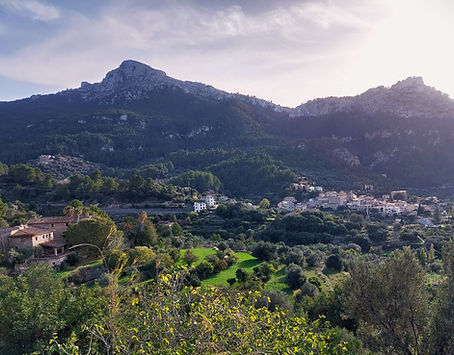
Estellencs
Stage 2: Ses Fontanelles – Estellencs
14.8 km 643 m elevation gain,
Highest point 1027 m, 4½ hours
So the start of our Dry Stone Route was in the middle of nowhere, at a country hotel called Finca Ses Fontanelles, just off the ubiquitous MA-10, which seems to follow the trail like a shadow. We dumped the car on a gravel dirt patch just off the road and went straight up into the mountains and above the tree line. Only a few other hikers around, and this was one of the rare occasions, when we felt detached from the bustling and often densely populated setting of the island. The wind was howling at great strength, so we decided against the final climb, 50 m up to Puig de Galatzo, at 1027 m the highest elevation in the southern section of the Serra de Tramuntana. A pleasant stroll down to Estellencs completed this stage and we enjoyed a nice caffeine hit on the sun terrace of the local bar where the waiter told us that the bus back to Ses Fontanelles only operates until the end of October. No taxi service in the village either. We somehow forgot that there is a rather convenient ride sharing service available all over Europe, so after some head scratching, I approached a middle-aged couple from Germany (of course) who were about to set off in their rental and asked whether they could give us a lift back to our car. After hardly any hesitation, the doors flung open and the 15 minute journey back to Ses Fontanelles was filled with the husband waxing lyrical about London and the UK and how dismal life in Germany had become of late. Clearly another case of someone with too much childhood exposure to Jürgen Drews.

Banyalbufar
Stage 3: Estellencs – Esporles
14.3 km, 546 m elevation gain,
Highest point 451 m, 4 hours
Clouds had moved in overnight, though the air continued to be weirdly warm and humid. Yesterday’s gale was still blowing, and it felt as if a hair dryer was chasing us. But that was just fine for today’s stage, since it mostly represented a hike through the woods with little elevation gains and hardly any vistas. In hindsight, we should have taken a detour down to the village of Banyalbufar for a little change of scenery but instead, after 4 hours we arrived in the busy town of Esporles, with locals going about their daily business, lending the place an authentic vibe that has somewhat gone missing from the polished appearance of Valldemossa which we had chosen as our overnight base. We stayed for an hour, happily watching the world go by, until the very punctual TIB bus arrived to take us back to Estellencs.
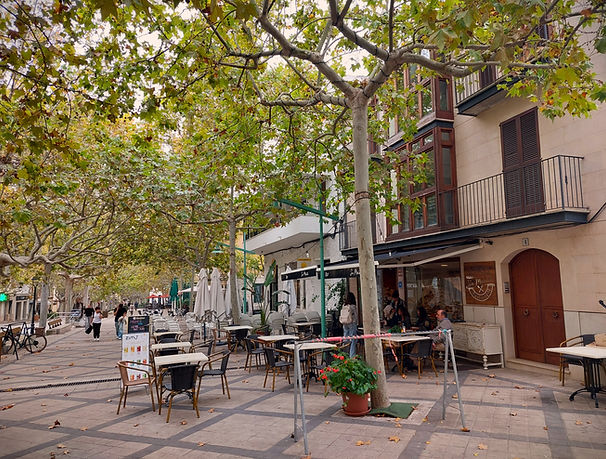
Esporles
Stage 4: Esporles – Valdemossa
10.5 km, 702 m elevation gain,
Highest point: 692 m, 3½ hours
This turned out to be a fabulous leg; probably my favourite one of the entire trail: through the outskirts of Esporles, past impressive country estates and up into the mountains with stupendous views back down to the valley and over across a high plateau with the Mediterranean Sea shining in the distance. The hike culminated in a steep descent down towards gorgeous looking Valldemossa where the day trippers and the occasional selfie-mania put us back onto planet mundane.

Valldemossa
Stage 5: Valldemossa – Deia
14.5 km, 715 m elevation gain,
Highest point 934 m, 5 hours
The starting point of that leg was just a couple of metres away from the front door of our accommodation. No car journeys today for once, and we hiked up a side valley and through a dense forest, gradually gaining altitude until we reached the top of Puig Caragoli, at 934 m. Clouds had started to roll in, and for the first time we had to get out our rain jackets, but as soon as we had climbed beyond the treeline, the clouds miraculously lifted, revealing a magical mountain landscape of peaks and deep ravines. It was a fabulous end to the first section of our journey.

Deia
Stage 6: Deia – Soller:
17.1 km, 529 m elevation gain,
Highest point 291 m, 4½ hours
It was March by the time we returned to the island, and the first hike of the northern section proved to be a gentle introduction. Just as with Stage 3, this part of the trail often felt like a filler leg: not too many vistas (apart from the lighthouse at Cap Goros with nice views across the sheltered bay to Port de Soller), mostly along a level and cobbly track. But we had just flown in the night before and greatly enjoyed being out in nature after what had been a miserable London winter. The vistas and mountain scenery could wait for another day. So we walked through scented pine forests, catching the occasional glimpse down the steep ravines of the north coast, whilst passing a lot of fenced-off properties There isn’t really much open countryside in Mallorca. Of course, up in the mountains, you can ramble until your heart is content, but down here in the valley, one encounters a marked population density, with affluent owners on their estates intend on maintaining their privacy.

Far de Cap Gros
Stage 7: Soller to Tossals Refuge
18.2 km, 1200 m elevation gain,
Highest point 905 m, 6 hours
Hard core hikers usually tackle this leg by leaving Soller, then climbing up into the interior of the Tramuntana before spending the night at the refuge in Tossals Verds. But we are far from being hard core, so we reverted to cheating by parking our car near the reservoir Embassament de Cuber, one of several lakes between Soller and Lluc. It is where the MA-10 meets the official GR 221 path and thus offers a handy entry point for an out-and-back hike. Thick clouds had started to move in, and we hiked uphill to today’s highest point at 905 m, before descending down to the refuge. That took two hours along a rocky path that was steep and slippery in places with a rope section thrown in for good measure. We just about managed to finish our packed lunch at the refuge before the rain set in; first a gentle drizzle, but just when we were about to reach the top of the ridge again, the heavens opened with driving rain, hail and strong winds. That was quite a workout: 900 m altitude change, on often lose footing in atrocious conditions. And although we cheated, today’s 5-hour hike extended to a little over 11 km.

Soller
Stage 8: Tossals Refuge to Lluc
14.3 km, 877 m elevation gain,
Highest point 1137 m, 5 hours
And since we cheated on Stage 7, we were forced to take another shortcut on the subsequent leg. The official route starts at the refuge in Trossals and winds its way all the way up to the top of Puig d’en Galileu, at 1137 m the highest point of the entire trail, before descending down onto a high plateau at the village of Lluc. Instead, we parked at the Son Massip Terme, once more a convenient location straight off the MA-10, and just outside of Lluc. Then it was 90 minutes through thick pine forest, before we eventually cleared the tree line not far below the summit. We hit the trail very early in the morning in the hope of avoiding the scheduled mid-day rain showers. We needn’t have bothered. Mist and fog obscured any views down into the valley, yet at mid-morning, when we were already halfway back down the mountain, the clouds lifted so that we could finally see the impressive, alpine-looking landscape through which we had been hiking through all this time. And the predicted rain didn’t materialise after all. Still, we managed to reach the top of the Tramuntana trail: 3 hours out and back, 9.2 km with an elevation gain of 550 m.

Gorg Blau
Stage 9: Lluc – Pollença
19 km, 360 m elevation gain,
Highest point 697 m, 5 hours
We had some friends who just happened to be on the island, joining us for this one. They chose a good day, since this stage was the most lenient of all sections. Rather conveniently, they brought along another vehicle, which saved us from a lengthy bus journey or Uber ride. The hike started with a gentle 30-minute ascent, before we were able to amble all the way down into the lush valley that leads to Pollença, through thick forests and past the odd luxurious (and of course fenced-in) finca. The day felt more like a lengthy stretching exercise than a strenuous physical endurance test, which was just fine by us.

Pollença
So how do we rate the Dry Stone Route in comparison with all the other long-distance hikes that Carlos and I had tackled over the years? If solitude is your thing, then you might be better off hiking the Menalon Trail in Greece. While undoubtedly beautiful, Mallorca’s GR 221 also sits in the middle of a densely populated island, with civilisation noises, hordes of cyclists, and fellow hikers (especially at weekends) never far away. And if you prefer to be overawed by nature, you might want to try the desert setting of the Cabo de Gata in Andalucia, or the windswept and wild scenery of the Fisherman’s Trail in Portugal. And if you are after an edge of the world experience, the circumnavigation of Santa Maria in the Azores archipelago might be a top contender. Still, the Dry Stone Route has much to offer. The vistas are varied and often glorious. The climate offers a chance to organise a tour even during the colder months of the year. Above all though, the different towns and villages along the way provide an attractive contrast to the physical experience of tackling a trail. Food, architecture, culture – the Tramuntana trail is never far away from these.

Port de Soller


